

By Nick Simonson
From a mild winter with limited snow to a warm spring, conditions were nearly ideal for ringneck pheasants in North Dakota over the past 12 months, and an increase of approximately 25 percent in birds observed statewide in summer roadside counts conducted by the North Dakota Game & Fish Department (NDG&F) reflected those favorable factors. While the average number of chicks per brood was off about 12 percent from the previous survey due to a cooler, wetter stretch across the Peace Garden State in June after the hatch which hurt recruitment, RJ Gross, NDG&F Upland Game Biologist points to a greater number of broods observed as buoying population surveys this summer.
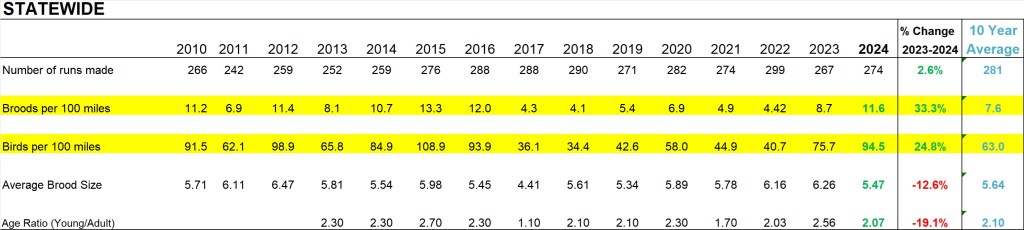
“It could have been fantastic, we had 11 months that were perfect for raising pheasants. But of course, June had to be cold and wet, and that impacted it a bit,” Gross stated, adding, “comparatively we are back to where we were before the 2017 drought.”
The statewide average of 94.5 pheasants observed per 100 miles is the highest total tallied by the agency in the past 10 years, and is nearly 50 percent higher than the 10-year average of 63. Similarly, statewide numbers of observed broods at 11.6 sets of chicks per 100 miles driven was the highest seen since 2016, when the average was 12, with the ten-year average being 7.6.
Better Trends, Welcome Rebounds
The northwestern survey district, which consists of an area roughly from the north shores of Lake Sakakawea west and north to the state line and Canadian border, was the showcase survey area, boasting bird tallies of 164 pheasants per 100 miles driven, up slightly from 2023, and the highest it has been in the last 10 years. Broods counted were also up, with nearly 21 seen per 100 miles driven, the second consecutive 10 year high after a nine-year average of just 6.6 broods from 2014 to 2022.
The southwestern survey district finally exhibited a strong rebound in this year’s survey, after struggling to overcome habitat deficiencies and brutal drought years in 2017 and 2021 which stifled recruitment of pheasant chicks, due to lack of insect production for the young birds to eat in the early days of life. Pheasants seen per 100 miles were up from 86.2 last year to 118.9 in 2024. Broods also spiked to 13.8 seen per 100 miles, increasing 42 percent from 2023, up from lows of 3 and 2.6 in 2021 and 2017 respectively.

“The southwest, they had the best production this year and the second most adults seen, so that was good and they’re about 75 percent of what they were before the 2017 drought. And there were definitely parts as you get farther and farther down in the southwest, it seems that is where the best production for pheasants were and that’s where a lot of people go; that Bowman-Hettinger-Mott area,” Gross details.
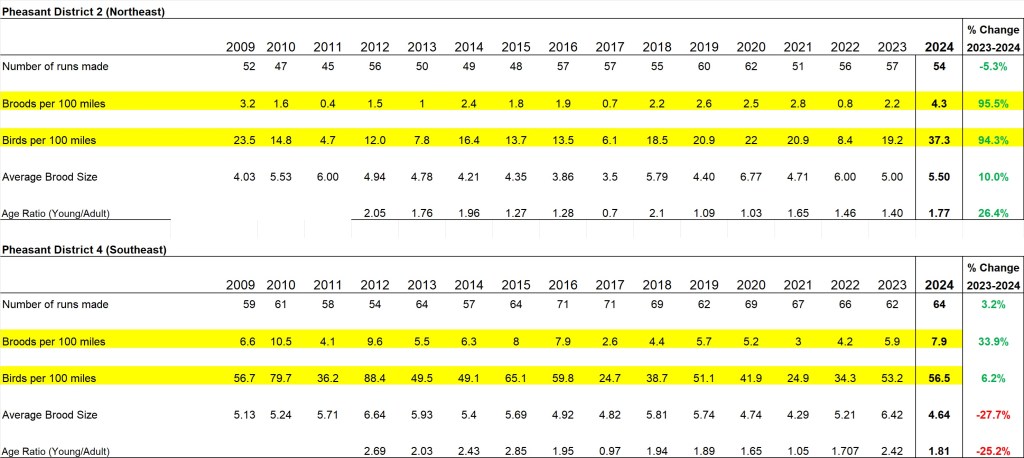
In North Dakota’s secondary pheasant range, the southeastern portion of the state posted modest gains with a 6.2 percent increase in pheasants observed, but a bump in broods counted by more than a third. In the northeast, which is bounded by the Missouri River on the west and I-94 in the south, pheasants observed jumped to 37.3 from last year’s tally of 19.2 and broods nearly doubled to 4.3 from 2.2 per 100 miles in 2023. Increases in the latter survey district typically were observed in those counties along I-94 and closer to the Missouri River.
Good Habitat, Just Not Enough
With significant rainfall this spring and summer, the grass remaining in the ground in North Dakota has been thick and lush, providing ideal rearing habitat where it has been available. However, the amount of areas of grass remains in a trough in Roughrider Territory, after a height of more than 3 million acres enrolled in CRP in 2006 to around 1 million acres now, which also impacts the amount of land enrolled in public access arrangements, like the NDG&F Private Land Open to Sportsmen Program (PLOTS), further limiting areas hunters can explore. While the pace of habitat removal and conversion to row cropping has dropped some, the trend of CRP acres expiring and marginal lands being placed back into production continues.
“The habitat is very thick and we are getting some dry areas in the far northwest and the far southwest so people have got to be aware of that and just be smart and not park in tall grass [to prevent fires],” Gross explains, hedging that the issue will remain the limited number of grassland acres on the landscape which will likely lower hunter access and total harvest: “my heart says 400,000, but my head says 350,000. The population is back to what it was when we harvested 500,000, but we also don’t have the number of hunters and like I said, access is tough. So, I’ll split the difference, and my guess will be 375,000,” he concludes on his annual estimate of total rooster pheasants harvested this fall.
The North Dakota general pheasant opener is set for Oct. 12 and the season runs until Jan. 5, 2025. The special youth pheasant weekend is slated for Oct. 5 and Oct. 6.
Simonson is the lead writer and editor of Dakota Edge Outdoors.
Featured Photo: Brood Bump. A tradeoff between more, but slightly smaller pheasant broods helped raise the number of pheasants observed in the NDG&F surveys of upland game this summer. Simonson Photo.
 dakotaedge.com