

By Nick Simonson
Once in a while on a couple small lakes and ponds I frequent with the fly rod where the panfish are huge and the pressure is light, particularly before the calendar flips over to May, there’s a midge hatch of epic proportions, and the bugs themselves are disproportionately large as well. Normally, when one considers the midge, it’s a tiny, mosquito-like insect that has all the swarming and buzzing and none of the biting. The worst they can do is get inhaled on a deep breath or get stuck in the corner of an eyeball while zipping from spot to spot on a lake. At their very best, and at the peak of their hatch, they bring the crappies and bluegills into the upper strata of the water column and make for a fast day of fishing.

Griffith’s Gnat
Hook: Dry Size 16-20
Thread: Black 6/0 or 8/0
Body: Peacock Herl
Hackle: Grizzly Dry
To match the hatch of these oversized morsels, I lean into both a dry fly and a soft hackled wet fly. The former being the Griffith’s gnat, a do-all two-material pattern consisting of a twirl of peacock herl and a wrap of grizzly dry fly hackle in its classic form. For a simple variation, I’ve used gray dubbing, black floss or other thin body material, and substituted cream or black hackle for the gray-and-black grizzly fibers that make it float on the surface. When the bigger midges are hatching, I’ll tie them up in size 16, and for general purposes, a selection of smaller ones in size 18 work well. Either way, when the big midges are around, this surface presentation draws strikes.
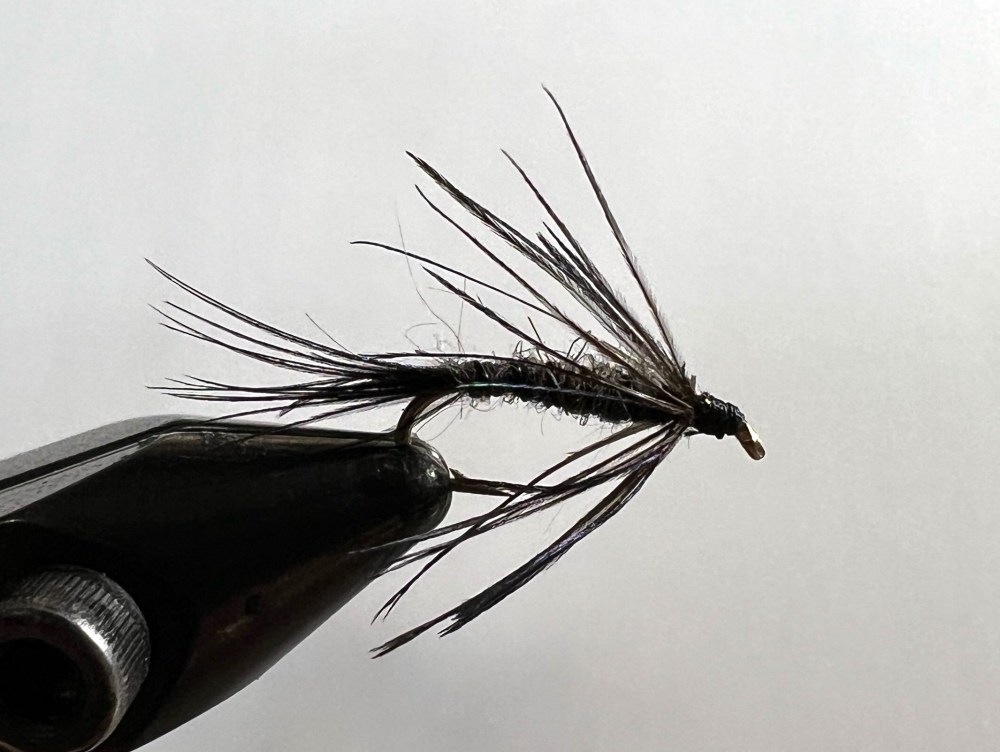
Dark Hare’s Ear Soft Hackle
Hook: Nymph Size 14-16
Thread: Black 6/0
Tail: Pheasant Neck Feather Fibers
Body: Dark Hare’s Ear Dubbing
Rib: Black Midge Ultrawire
Collar: Pheasant Neck Feather
In the midst of a midge hatch, another fun fly that incorporates my favorite upland bird is a soft hackled wet fly consisting of dark hare’s ear dubbing, a twist of black midge wire and a turn of a neck feather from a rooster ringneck pheasant for the collar. The blackish-blue sheen of the hackle coming from that unique plume on perhaps the most notable part of the rooster gives off a lifelike cue in the water and the pulsing of each dark fiber seems to simulate a hatching insect struggling up to the surface to take flight. Worked with a slight rise and a few twitches, this still water specialty is a great go to for midge hatches, and even when nothing is hatching as an exploratory pattern.
Midges and their larval stages make up the early season meals for many panfish and sustain trout throughout the lean months as well before all the other insects get going in spring. They are the building blocks of the food chain in many waters and are an easy grab for fish when these tiny insects are making their way to the surface en masse. This pair of patterns is just a start in mimicking midges; do some research, check pattern books, and stock up now ahead of their emergence with the imitations that will fool fish whenever there’s a good hatch that gets going this spring.
Simonson is the lead writer and editor of Dakota Edge Outdoors
Featured Photo: Buzzing. While midges are often thought of as relatively small insects, some hatches of really large ones can set off a massive feeding frenzy. Simonson Photo.
 dakotaedge.com