

By Nick Simonson
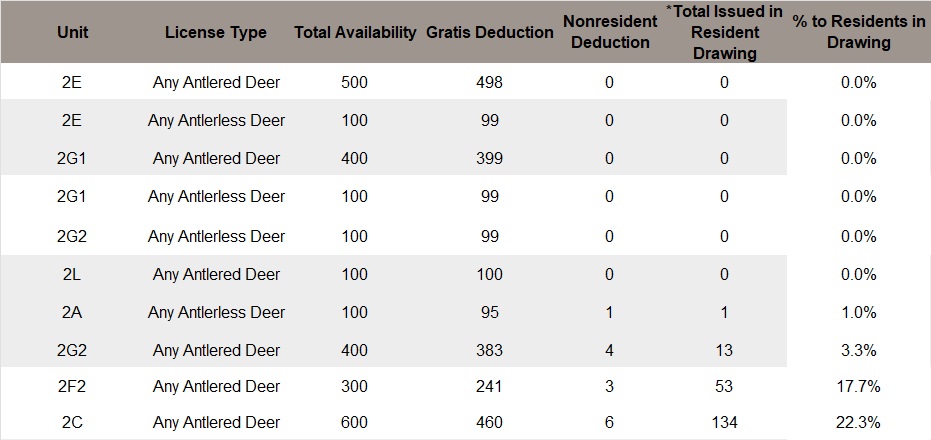
In a few deer hunting units this summer, hunters were audibly befuddled by the fact that they had once again been snubbed for their firearms lottery deer license in North Dakota, despite a number having accumulated significant preference points. While the allotted lottery firearm deer tags statewide were at a half century low, with only 42,000 available to hunters reflecting diminished populations of the animals, approximately the same annual number of gratis tag applications – 12,000 or so – were taken by the North Dakota Game & Fish Department (NDG&F) for the upcoming season. With those tags coming off the top of all firearms deer tags allotted to hunters in the state, the math is much more granular, says Casey Anderson, NDG&F Deputy Director.
“Gratis comes off first. Now, when you just look at those all-encompassing numbers it probably doesn’t tell the whole story, because in certain units some of those gratis applicants didn’t even draw their license, because the number of licenses available wasn’t even available for the number of gratis applicants,” Anderson explains, adding, “it depends on the number of applicants for each unit and we did have units where we did not have enough licenses for gratis applicants, so they went into a lottery for the gratis, for those licenses. We had some units where we had very few left after gratis for the general public to have a crack at.”
Anderson further points to opportunities in western North Dakota available to those hunters who are willing to travel and aren’t as particular about the gender or type of deer they’re able to harvest. This season, more than 2,900 firearm deer tags were available in a second lottery to those residents who were unsuccessful in the first lottery, and more than 1,100 firearms tags remain on a first-come, first-served basis for hunters in the fall of 2025. While the low number of deer tags is disappointing in general to hunters, it also exhibits the greater issue which NDG&F is aware of, and that is scarcity of good habitat for the state’s deer populations.
“It just depends on those populations in those areas and we’re really in a state right now where in some areas habitat is pretty low, and populations are pretty low. We’re trying to maximize the ability for the deer herd to rebound, and yet still have some opportunity out there, that balance that we always talk about,” Anderson comments.
In those North Dakota hunting units where all or substantially all of the tags were awarded to landowners, such as 2E, 2G1 and 2G2, those requesting gratis tags were put into a lottery to specifically award those tags, leaving none for the general lottery applicants. In this era of low habitat, slow deer population recovery from recent harsh winters and disease outbreaks, those hunters affected by their zero odds in the application process may be rightfully upset and looking for other options, one of which may have already established precedence in the state.
Changes Ahead?
In the 2025 legislative session, concerned pronghorn hunters in North Dakota approached the governing body with Senate Bill 2155 (SB 2155) which curtailed the number of gratis tags available to landowners in those units which may be open to pronghorn hunting in a given fall. Where previously the first 50 tags were given to landowners and the balance was split between gratis tags for landowners and lottery tags for the general public, SB 2155 made it an even split, without the guaranteed 50 tags being issued to landowners without charge. This process, which brought about the change Anderson details, is one that is solely governed by the legislature and not the NDG&F, but requires a good deal of planning and communication ahead of time. Any such changes to the deer gratis tag process or allotments then would have to go the same route through the state legislature, as SB 2155 did before its approval. The amended process becomes law for the upcoming pronghorn lottery in North Dakota, typically held in early August.
“It’s something that you don’t just go up there and try to change it,” Anderson details of the legislative steps around gratis tags and all their possible pitfalls for hunters, continuing, “those conversations have to happen way before the legislative process starts, because you’ll fill rooms and it’s not going to come out the way you think it’s going to come out.”
More information on how the North Dakota firearm deer gratis tag process works can be found in North Dakota Century Code section 20.1-03-11, subsection 3. Results from the 2025 firearm deer license lottery, including the number of gratis tags deducted from the total offered in each unit, can be found at https://gf.nd.gov/licensing/lotteries/summary/deer. Currently more than 1,100 firearm deer licenses remain available in four units for the November firearm season, and will be issued on a first-come, first-served basis beginning Aug. 13 at 8 am central time via the NDG&F website at gf.nd.gov.
Simonson is the lead writer and editor of Dakota Edge Outdoors.
Featured Photo: In some units, licenses for the 2025 November firearm deer season were not available to the general public, as gratis tags issued to landowners consumed all available tags in the hunting area before the general lottery was conducted. Firearms tags for 2025 were at a 50-year low of 42,000. Simonson Photo.
 dakotaedge.com